-
 Antoine Roney [Lecture]
 Philadelphia-born saxophonist Antoine Roney has been a distinctive voice in jazz for over four decades. After studying with Jackie McLean at the Hartt School of Music, he worked with a long line of greats including Clifford Jordan, Donald Byrd, Rashied Ali, Arthur Taylor, Freddie Hubbard, Elvin Jones, and his late brother, Wallace Roney. An accomplished bandleader with several albums to his name, he is also the father of rising jazz star Kojo Roney, who often features in his trio.
-
 Jerome W. Haferd [Lecture]
 Jerome W. Haferd is a New York–based licensed architect, public artist, and educator, known for his deep engagement with re-centering marginalized histories in Harlem's built environment.
-
 Elleza Kelley [Lecture]
 Elleza Kelley is an Assistant Professor of African American Studies and English with expertise in black geographies, and radical spatial practices that explore the intersections of literature, art, and place.
-
 k. kennedy Whiters: (un) Redact the Facts [Lecture]
 kennedy is a preservation architect, published writer, and guest speaker. She is the founder of wrkSHäp I kiloWatt, a historic preservation, and owner's representation. It is home to Black in Historic Preservation, Beyond Integrity in (X), and (un) Redact the Facts. kennedy has been featured by the Advisory Council of Historic Preservation. kennedy is also the founder of New York architecture firm studio KW Architecture, PLLC.
-
 Kazembe Balagun [Lecture]
 Kazembe Balagun is a writer, cultural critic, and outreach coordinator at the Maysles Documentary Center in Harlem. His work focuses on the intersection of Black radical thought, cinema, and community organizing.
-
 Imani Rashid [Lecture]
 Imani Rashid is an entrepreneur, teacher, visionary, event planner, Godmother to many, leader, Yoruba Priestess, mentor, friend and sister to others and a founding member of Salsa Soul Sisters (the oldest Black lesbian organization in the United States). Imani has dedicated her life to enriching and expanding the education of young children using the principles of Kwanza and creative practices such as drumming and aviation. Imani founded the Yoruba Cultural Center of New York City in Harlem in 1990 to gather Afro-diasporic people, primarily of the NJ-NY-CT area, to share history, language, divination, songs and dances of the Orishas, and the cosmology of the Yoruba People of Southwest Nigeria. The Yoruba Cultural Center closed in 1993, but its community-building and impacts have been lasting, and the center will resume its Saturday Night Lecture Series on Saturday, February 15, 2025.
-
 Glenn Hunter [Lecture]
 Glenn Hunter is the Co-Founder and Co-Executive Director of Harlem Cultural Archives, a 501(c)(3) not-for-profit historical society dedicated to gathering important oral history from the Harlem community. To date, the organization has conducted videotaped interviews with nearly 200 accomplished Harlem residents. Glenn is a career educator specializing in math and information technology. In addition to his role as an Adjunct Lecturer at Baruch College, Glenn is a dedicated community organizer and advocate.
-
 Emily Holloway & Amber Jamilla Musser [Lecture & Discussion]
 The Place Memory and Culture Incubator at Spitzer is pleased to invite all students, faculty, staff, and guests to the upcoming Presentation & Discussion / Q&A featuring Amber Jamilla Musser and Emily Holloway and moderated by jah elyse sayers.
This event will be held in person at the Spitzer School of Architecture, first floor, Sciame Auditorium (Room 107) and will occur this Thursday April 10th, 2025 at noon.
Amber Jamilla Musser is a professor of English and Africana studies at the CUNY Graduate Center. She writes and researches at the intersections of race, sexuality, and aesthetics. In addition to writing art reviews for The Brooklyn Rail. She has published widely in queer studies, black feminism, psychoanalysis, and critical theory. She is the author of Sensational Flesh: Race, Power, and Masochism (NYU Press, 2014), Sensual Excess: Queer Femininity and Brown Jouissance (NYU Press,
2018), and Between Shadows and Noise: Sensation, Situatedness, and the Undisciplined (Duke University Press, 2024).
Emily Holloway, PhD, is the Associate Managing Editor of Urban Affairs Review and a postdoctoral fellow at Drexel University. Her book project, “Domino in the Longue Durée: Racial Capitalism and the Urban Question,” reconstructs the prehistory of the Domino Sugar Refinery in Williamsburg, Brooklyn, through the site’s connections to the Caribbean sugar plantation complex. She has a PhD in Geography from Clark University and a master’s degree in urban policy from Hunter College. She has worked with several different community development and urban research institutes in New York City and Philadelphia, including the Bronx Cooperative Development Initiative, the Brooklyn Waterfront Research Center, and the Urban Heritage Project at the University of Pennsylvania.
-
 Najha Zigbi-Johnson [Lecture]
 Najha Zigbi-Johnson is a writer, educator, and cultural organizer. Her Harlem-based practice sits at intersections of the built environment, contemporary Black art, and social movement history. She is the editor of "Mapping Malcolm," a publication that brings together artists, transnational community leaders, and scholars who explore the politics of Black space-making.
-
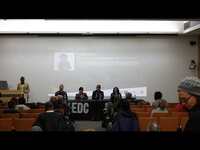 Harlem African Burial Ground Community Meeting (at the Spitzer School of Architecture)
 In this panel, consisting of architects and designers, they discuss the importance of the African Burial ground and importance of how we bury our dead. This revolutionary act of remembrance reclaims their humanity. How do we learn about this significant history through the landscape, through design, or through the built environment?
-
 "Franco (the Great) Gaskin"
 The Place, Memory & Culture Incubator was fortunate to host Franco (the Great) Gaskin at the Spitzer School of Architecture!
The Harlem artist, known for his 125th street storefront gate paintings spanning decades, shares his work and legacy.
Franco was one of the community partners for the Place Memory & Culture Incubator during the Spring 2024 “Generative Harlem Histories” Studio coordinated by Professor and Co-Director of the PMCI Jerome Haferd alongside co-faculties Gerardo Ciprian, Nina Cooke John, nia Love, and Chat Travieso.
This lecture was moderated by the PMCI’s PI and Co-Director Jerome Haferd in conversation with Franco Gaskin and Community Engagement Specialist Anthony Carrión.